
Maxim Kazmin, 123R
Container and hardware e-virtualization under one roof
Double Sure
The Proxmox Virtual Environment, or VE for short, is an open source project [1] that provides an easy-to-manage, web-based virtualization platform administrators can use to deploy and manage OpenVZ containers or fully virtualized KVM machines. In creating Proxmox, the developers have achieved their vision of allowing administrators to create a virtualization structure within a couple of minutes. The Proxmox bare-metal installer will convert virtually any PC into a powerful hypervisor for the two most popular open source virtualization technologies: KVM and OpenVZ.
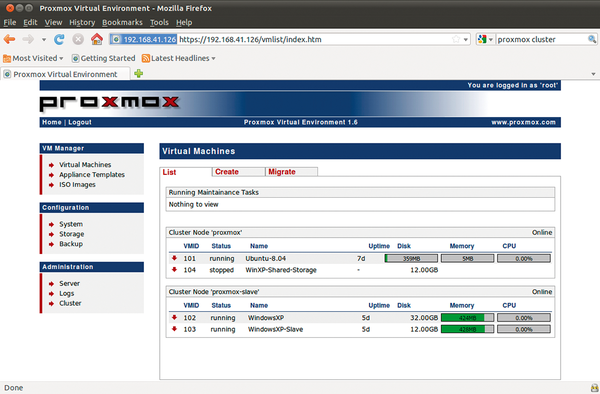
The system lets you set up clusters comprising at least two physical machines (see the "Cluster Setup" box). One server always acts as the cluster master, to which you can assign other servers as nodes. This is not genuine clustering with load balancing, but the model does support centralized management of all the nodes in the cluster, even though the individual virtual machines in a Proxmox cluster are always assigned to one physical server. The clear-cut web interface facilitates the process of creating and managing virtual KVM machines or OpenVZ containers and live migration of virtual machines between nodes (Figure 1).
...

Buy this article as PDF
(incl. VAT)
Buy ADMIN Magazine
Related content
-
Container and hardware e-virtualization under one roof
The Proxmox distribution specializes in virtualization, letting you deploy and manage virtual servers with OpenVZ and KVM at the same time.
-
Proxmox virtualization manager
 Proxmox has been working for years on their virtualization manager that does not require a cloud. We look at the improved reliability and new features in version 5.0.
 -
Automating deployments on Proxmox with OpenTofu and cloud-init
 Use OpenTofu and cloud-init to deploy virtual machines in a Proxmox hypervisor and populate them automatically with services.
 -
Operating system virtualization with OpenVZ
The virtualization technology market is currently concentrating on hypervisor-based systems, but hosting providers often use an alternative technology. Container-based solutions such as OpenVZ/Virtuozzo are the most efficient way to go if the guest and host systems are both Linux.
-
Operating system virtualization with OpenVZ
 The virtualization technology market is currently concentrating on hypervisor-based systems, but hosting providers often use an alternative technology. Container-based solutions such as OpenVZ/Virtuozzo are the most efficient way to go if the guest and host systems are both Linux.