
OpenStack workshop, part 1: Introduction to OpenStack
What OpenStack Really Wants
The end of September was marked by the popping of champagne corks down at the OpenStack project: Right on schedule, the project released a new version of its own cloud environment, OpenStack 2012.2 Folsom, adding many of the features that had been painstakingly developed and maintained over the preceding months. OpenStack is reliable when it comes to its self-imposed release cycle: Every six months – in October and April – a new version of the Python software sees the light of day.
The fact that the release cycle and the release data match those of Ubuntu is no coincidence: Mark Shuttleworth himself has stated that the projects are designed to be, and are, closely linked. Thus, it's also no accident that the entire OpenStack project relies on development tools by Canonical and develops almost exclusively in Launchpad (Figure 1). When Ubuntu made the whole thing more or less official back in May 2011 and dropped Eucalyptus in favor of OpenStack as its cloud solution, a murmur went through the developer community.
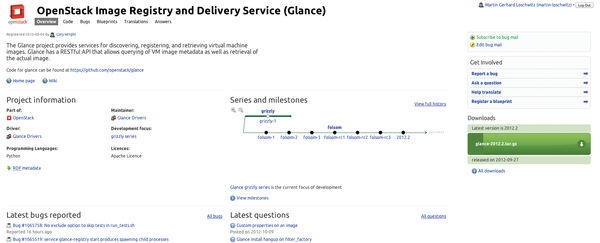 Figure 1: All OpenStack development relies on Canonical's Launchpad; thus, close interaction with Ubuntu was assured from the outset.
One, Two, Three …
Some observers found the whole thing rather strange at the time. Why would Canonical force a well-functioning solution to walk the plank and replace it with an environment, which, at the time, was hardly "enterprise-ready"? Come to think of it, what was the OpenStack developers' motivation for entering a market that other projects, such as Eucalyptus and OpenNebula, had already divided up among themselves? Was there really room for another "big player"?
The answers to all these questions became clear in April 2012: Canonical positioned Ubuntu 12.04 as the first enterprise distribution with long-term support that includes a well-integrated cloud solution, and, because Canonical had been around from the start of OpenStack, it was able to influence many of the seminal developments in OpenStack. Ubuntu has thus cast its own role in the cloud industry: If you want a cloud with Linux, only Ubuntu currently gives you the entire system along with support from a single source.
A direct comparison of the Eucalyptus, OpenNebula, and OpenStack development models shows the greatest differences between the projects. Whereas Eucalyptus and OpenNebula are backed by individual companies that have built communities around their products, but otherwise tend keep the covers on their products, the OpenStack cloud was designed as a collaborative project that was open to all comers from the outset. Although some scoff that the three environments ultimately do the same thing, only OpenStack can claim to have found more than 180 official supporters in the industry in the past two years – including such prominent names as Dell and Deutsche Telekom. The initial project by GitHub and NASA has thus turned into quite a successful beast.
What the Cloud Needs
Certainly, OpenStack is a permanent fixture in the cloud landscape. However, how well does OpenStack currently support the cloud? You can only answer this question meaningfully if it is clear what the cloud is supposed to do, and that has not been clearly defined precisely because the term has been bandied about the IT industry for more than two years.
Most infrastructure providers want to sell two services to their customers by introducing cloud environments: computational power in the form of virtual machines and storage space for data on the web.
Virtualization is more important than storage offerings á la Dropbox. However, a virtualization solution is still not a cloud. What the environment additionally needs to offer, according to the ISPs, is automation – meaning that once services are set up by the service provider, customers can stop or start them independently, with no further intervention on the part of the provider. For this to happen, the environment needs a user interface that is usable by non-IT professionals. These "self-servicing portals" are probably the biggest difference between traditional virtualization environments, such as VMware and the like, and cloud software, such as OpenStack, even though solutions such as oVirt by Red Hat illustrate that the borders here are starting to blur.
So, what solutions have the OpenStack developers designed to face the above challenges?
OpenStack Is Modular
In principle, the following applies: The OpenStack architecture is modular, and each task is assigned to a single component that provides the required functionality. In OpenStack-speak, a distinction is made between the actual core components of the software and the add-on tools. The add-ons handle features needed in individual use cases for which the majority of users have no interest.
The "OpenStack" name is an umbrella for the core components. Additionally, the "incubated projects" category applies to software that will become part of the core in the foreseeable future, but whose development has not yet progressed to a stable stage. The number of core components has increased in Folsom. Besides Keystone (authentication), Glance (images), Nova (cloud controller), Dashboard (web interface; Figures 2 and 3), and Swift (storage), they now include Quantum, which takes care of the network in the cloud, and Cinder, which provides memory in the form of block storage to virtual machines.
 Figure 2: The Dashboard is the central user interface. Existing VMs, referred to as "instances," can be deleted and started here.
 Figure 3: The dashboard also provides a brief overview of the resources used within a defined period.

Buy this article as PDF
(incl. VAT)
Buy ADMIN Magazine
Related content
-
Getting started with OpenStack
 Selecting the correct OpenStack components for your use case and setting up the stack can be highly complex. This first article of a series prepares admins for practical OpenStack applications.
-
The state of OpenStack in 2022
 The unprecedented hype surrounding OpenStack 10 years ago changed to disillusionment, which has nevertheless had a positive effect: OpenStack is still evolving and is now mainly deployed where it actually makes sense to do so.
-
OpenStack: Shooting star in the cloud
 OpenStack is attracting lots of publicity. Is the solution actually qualified as a cloud prime mover? We take a close look at the OpenStack cloud environment and how it works.
-
OpenStack: What's new in Grizzly?
 In mid-April, the OpenStack developers published the latest version of their free cloud environment, code-named Grizzly.
-
OpenStack: Shooting star in the cloud

OpenStack is attracting lots of publicity. Is the solution actually qualified as a cloud prime mover? We take a close look at the OpenStack cloud environment and how it works.