
Photo by Patrick Humm on Unsplash
Isolating Containers from Container Attacks
All Alone
In recent years, containers have become some of the most important building blocks of today's IT infrastructures. They are relatively frugal in terms of system resources, are easy to manage, are flexible, and enable quick development, deployment, and scaling of applications. Whether in cloud environments, in a DevOps context, or in traditional data centers, containers are everywhere you look. But as their importance grows, so does the interest of attackers.
The container escape – that is, the moment an attacker breaches the isolation layer and gains access to the host system or other containers – is a particularly critical scenario that not only jeopardizes the security of an individual application, but often that of the entire underlying infrastructure. To operate your containers securely, you need to understand the basic technology of how a container escape works and the targeted actions you need to take to mitigate the risk. A look at real-world cases from the recent past offers insights into how container environments can be hardened so that even the most sophisticated escape techniques fail.
Isolated Applications
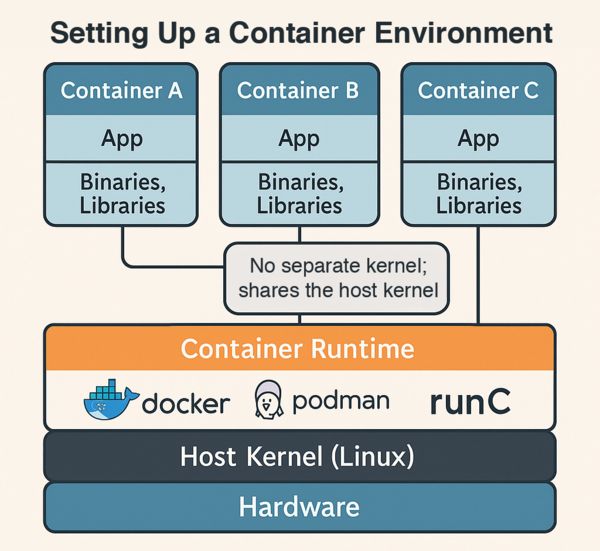
To the outside world, containers appear almost like small, separate virtual machines (VMs) with their own filesystems, processes, and networks. In reality, though, they all run on the host's operating system kernel. The impression of strict separation arises from several Linux kernel mechanisms that interact and together create a kind of virtual environment (Figure 1).
...

Buy this article as PDF
(incl. VAT)
Buy ADMIN Magazine
Related content
-
Improving Docker security now and in the future
 The focus for container solutions such as Docker is increasingly shifting to security. Some vulnerabilities have been addressed, with plans to take further steps in the future to secure container virtualization.
 -
Securing the container environment
 Implement a good, robust defense with an in-depth strategy of applying multiple layers of security to all components, including the human factor.
 -
Dialing up security for Docker containers
 Docker containers are a convenient way to run almost any service, but admins need to be aware of the need to address some important security issues.
 -
Securing AI model deployments with SELinux
 We assess the effectiveness of SELinux in protecting AI model deployments on RHEL 9, demonstrating its ability to block unauthorized access, modification, and resource exploitation through mandatory access control.
 -
Keeping Docker containers safe
 Docker containers introduce serious security problems, but you can employ a number of methods to deploy them securely.