
© Kozinia, 123RF.com
vSphere 5 vs. XenServer 6
Major LeaguePlayoffs
According to market researchers [1], VMware and Citrix currently account for between 80 and 88 percent of the US and UK hypervisor market (Figure 1) and about 71 percent in Western Europe. vSphere 5 [2] by VMware started to move into the server racks in the summer of 2011, but while I was researching this article, Citrix suddenly burst onto the scene with the XenServer 6.0 release [3].
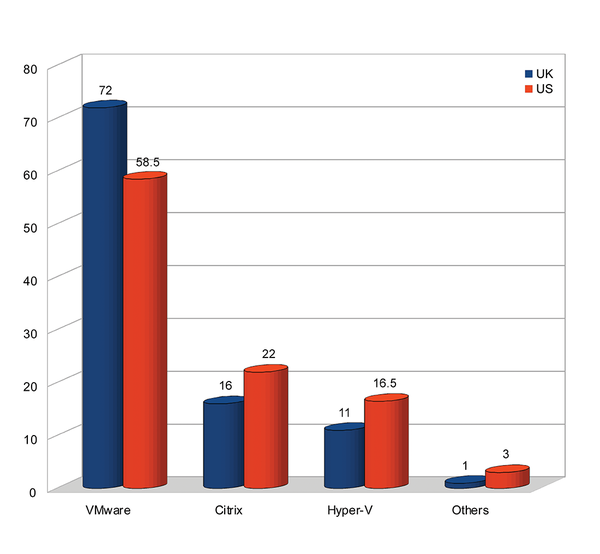 Figure 1: Market share (%) of primary hypervisors in the US and UK 2011Q2. (Source: V-index [1])
XenServer 6
Vendor: Citrix [3].
Type: x86 hypervisor for virtual machines with almost any operating system; wide-ranging management and monitoring solutions.
License: Proprietary with open source components.
Costs: Official pricing in a variety of currencies is available at the XenServer website [9].
Test version: Two XenServer trials are available [10].
Although I would have
...

Buy this article as PDF
(incl. VAT)
Buy ADMIN Magazine
Related content
-
VMware Tools

VMware’s recent announcement about vCloud Hybrid Service involves expansion of the vCloud suite toward a public/hybrid cloud. In this article, we attempt to shed some light on the huge number of VMware products.
-
An overview of VMware tools
 VMware's recent announcement about vCloud Hybrid Service involves expansion of the vCloud suite toward a public/hybrid cloud. In this article, we attempt to shed some light on the huge number of VMware products.
 -
Adapting VMware vSphere for state-of-the-art hardware
 VMware vSphere is still the most comprehensive virtualization solution on the market, and the manufacturer has made it even easier to install on the latest crop of hardware by adding the Image Builder and an option to install from a USB memory stick.
 -
Automate your VMware configuration with Puppet
 In ESXi environments, the powerful Puppet automatic configuration tool can perform its services and roll out VMs automatically. A test environment shows the benefits of Puppet in conjunction with vSphere.
 -
Citrix XenServer 6.2 goes open source
 In June, Citrix released the latest version of XenServer Enterprise as open source software. The manufacturer hopes to benefit from input from the community, attract more customers for its desktop virtualization solution, and improve its market position.
Subscribe to our ADMIN Newsletters
Subscribe to our Linux Newsletters
Find Linux and Open Source Jobs
Most Popular
Focus On Self-Hosting
• Reliable Network Storage with TrueNAS Community Edition
• Self-Hosted File Syncing with Seafile
• Wiring the Modern Stack with Node-RED
• Self-Hosted Collaboration with Forgejo
• Self-Hosted PaaS with Coolify
• Build and Host Docker Images
• Self-Hosted Pritunl VPN Server with MFA
Support Our Work
ADMIN content is made possible with support from readers like you. Please consider contributing when you've found an article to be beneficial.