« Previous 1 2 3
Harden your Linux servers to stop malware
Keep It Clean!
Wazuh Open Source SIEM
Wazuh is a fully-fledged SIEM platform that puts an end to the "just install it" principle. The basic idea is that an agent runs on each end device and reports to the Wazuh server. The server analyzes the information, creates an overview, and assesses the security status of the infrastructure.
For a first impression or in a small environment, Wazuh provides a virtual machine [6] that contains all services and appears at https://<Server IP Address> after booting. Without agents, though, the web pages will be largely empty. The Deploy new agent button shows how the agent software is installed on clients for various operating systems and distributions.
Nothing happens immediately after rolling out the agents. Wazuh requires patience, because the agents perform their malware and integrity checks on a schedule. Gradually, the dashboards on the Wazuh website fill up, providing information on the health status (Figure 4).
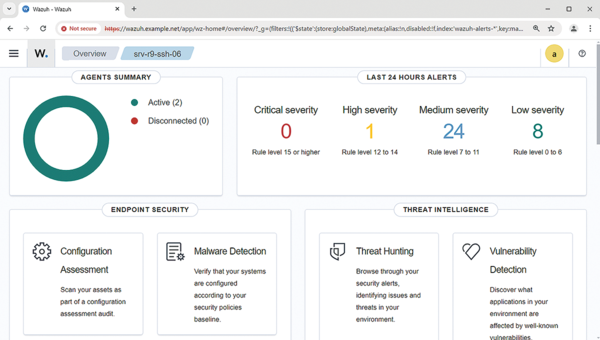 Figure 4: Wazuh collects reports from all agents to paint an overall picture of the security situation. Here, the agent has detected and reported several vulnerabilities.
Wazuh describes itself as an open source security platform [7] and goes far beyond basic protection, with a focus on a holistic view of all endpoints rather than on malware protection for a single computer.
Conclusions
Even though nasty viruses mainly attack Microsoft systems, Linux is not automatically off the hook. The smaller number of malware programs (Table 1) is reflected in the restricted selection of AV products (see the "Even More Security" box). The first port of call is ClamAV, which is available for virtually every distribution and has been sniffing around local databases for more than 20 years. If you want to protect your environment against rootkits, you will want Rootkit Hunter or Linux Malware Detect to scan your systems on a regular basis. Going one step further, to ensure a uniform level of protection on all computers, you can look into security platforms such as Wazuh.
Table 1
Linux Anti-Malware Tools
| ClamAV | Linux Malware Detect | Rootkit Hunter | ServerProtect | |
|---|---|---|---|---|
| Version | 1.4.0 | 1.6.5 | 1.4 | 3.0 |
| Release year | 2001 | 2009 | 2006 | 2005 |
| Language | C/C++ | Shell/Perl | Shell/Perl | – |
| Installation complexity | Easy | Low | Easy | High |
| Complexity of use | Easy | Moderate | Moderate | Easy |
| Real-time scan | Y | Y | N | Y |
| Documentation | + | + | + | ++ |
| Open source | GPLv2 | GPLv2 | GPLv2 | No |
| Native/Docker | Yes/Yes | Yes/No | Yes/No | Yes/No |
| Commercial support | Yes | No | No | Yes |
Even More Security
The list of exciting projects is far from over, but their areas of application overlap in some cases, such as tools for checking file integrity (e.g., Tripwire, Integrit, and AIDE). These tools create checksums for each system file and store them in a database, repeating the process at regular intervals and comparing the current and previous checksums. If the values do not match, something has changed in the file content, and it is up to the administrator to determine whether it is malware or an update.
Security auditors such as Lynis, Trivy, and OpenVAS take a different approach: They compare the software versions and settings of the existing Linux system with best practices and report any deviations. After completing its scan, Lynis is very helpful and provides specific recommendations (e.g., determining whether protocol rds (reliable datagram sockets) is really needed on the system).
Infos
- ClamAV: https://www.clamav.net
- ClamAV Unofficial Signatures Updater: https://github.com/extremeshok/clamav-unofficial-sigs
- Fangfrisch: https://rseichter.github.io/fangfrisch/
- Rootkit Hunter: https://rkhunter.sourceforge.net
- Linux Malware Detect: http://www.rfxn.com/projects/linux-malware-detect/
- Wazuh VM: https://documentation.wazuh.com/current/deployment-options/virtual-machine/virtual-machine.html
- Wazuh: https://wazuh.com
« Previous 1 2 3

Buy this article as PDF
(incl. VAT)
Buy ADMIN Magazine
Related content
-
OpenSMTPD makes mail server configuration easy
 The OpenBSD origins of the OpenSMTPD mail transfer agent makes SMTP easier to implement and manage and more secure.
-
Look for file changes and kick off actions with Watchman
 Watchman watches files and directories for changes and triggers actions when specific changes are noted.
-
Virus scanner and content filter with AD authentication
 You might want to reap the benefits of Active Directory's single sign-on for your virus scanning and content filtering. If you also use Squid to handle user access to the Internet, you have a front-row seat for "When worlds collide."
-
Hardening mail servers, clients, and connections
 If you don't want to hand over your mail to a corporation, you have to operate your own mail server. Securing it sensibly involves some effort.
-
A free anti-spam tool for Exchange environments
 Anti-Spam SMTP Proxy gives companies who deploy their own email server a free, but extremely powerful, anti-spam solution.
Subscribe to our ADMIN Newsletters
Subscribe to our Linux Newsletters
Find Linux and Open Source Jobs
Most Popular
Focus On Self-Hosting
• Running Your Own Matrix Server with Synapse
• Reliable Network Storage with TrueNAS Community Edition
• Self-Hosted File Syncing with Seafile
• Wiring the Modern Stack with Node-RED
• Self-Hosted Collaboration with Forgejo
• Self-Hosted PaaS with Coolify
• Build and Host Docker Images
• Self-Hosted Pritunl VPN Server with MFA
Support Our Work
ADMIN content is made possible with support from readers like you. Please consider contributing when you've found an article to be beneficial.